Nausicaa of the Valley of the Wind: A sincere message, beautifully told, by a deserved classic

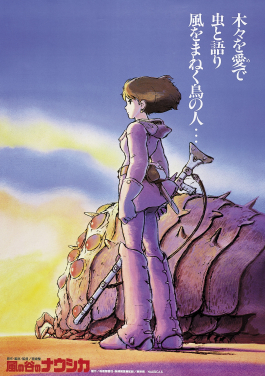
“Nausicaa of the Valley of the Wind” is another interesting film for me, since I was certainly familiar with the English dub in my youth. Even then, I only knew about a few isolated lines and moments. This was my first time seeing the entire film at once, and also my first exposure to the Japanese version. The 2005 dub contains many recognizable actors (Patrick Stewart, Edward James Olmos and Uma Thurman, to name a few), but it was also released 20 years after the film itself. Therefore, I feel a little more justified separating it from Hayao Miyazaki’s original vision. I’ll also be clear: I’m not fluent in Japanese, nor am I the best at evaluating a vocal performance in a language I don’t understand. I can, however, recognize cadence, inflection, rhythm, passion…key components to any actor’s ability and skill set. That definitely helped with watching the authentic cut of a well known Anime movie, and I’ll dispel any doubt right now…it’s a rewarding experience.
The story is set a full millenia into the future, where the world has been ravaged by climate change and human devastation. An expansive toxic jungle, the “Sea of Decay”, now covers large parts of the earth’s surface. Meanwhile, the militant nation Tolmekia begins invading other territories - including the titular valley - with the goal of acquiring resources and resurrecting an ancient weapon. Miyazaki went on to cover themes of war and ecological preservation in his other projects, but this film started that trend to a degree. It was influenced by several other science fiction works, most notably Frank Herbert’s 1965 novel “Dune”, and I’ll include some brief links below for anyone who wants some extra research. Also, despite being associated with other Ghibli films, “Nausicaa” predates many of the studio’s most famous pictures. I think it mainly gets that label because of Miyazaki and other shared talent.
I will say, first and foremost, that the presentation of this post apocalyptic earth is very well done. While the human designs aren’t the most detailed by today’s standards (simply because of the animation style and era), the environmental compositions are superb. The use of intricate shading and texture for the toxic forest is incredible, and the same can be said for the ecosystem’s design. It feels alive and thriving; The fungus spores, noxious vapours and abundant invertebrates all appear grounded in real biology. It’s a bleak and lethal habitat for humans, but a rather beautiful home for everything else.
The most formidable among these lifeforms are Ohmu, which essentially resemble shelled insects the size of buildings. Their anatomy is quite unique, with a large number of dome shaped eyes, segmented bodies, yellow tendrils and blue blood. They are capable of great destruction, but are also shown to be perceptive, social and empathetic animals. Visibly they're again based on insects of some kind, but I’d also compare their size and behaviour to elephants. Just like pachyderms, Ohmu have the simultaneous capacity for extreme carnage and great compassion, depending on the scenario. “Nausicaa'' basically sets the Ohmu as a central, neutral character. They don’t necessarily want human contact, nor do they seek violence for shallow spite or pleasure. When a herd of them charge together in the movie’s climax, the sounds we hear aren’t terrifying roars, but pained cries. They can’t control themselves in that rage - they act purely on defensive instinct. The Ohmu are, simply put, a force of nature that humanity has forgotten to respect.
Another small note: I have yet to mention music on this blog, and how it can impact animation. It’s an important element to any film, and not surprisingly, it’s a supportive aspect of “Nausicaa”. Specifically, the use and absence of music is deftly explored with the movie. There are some solid instrumentals on display, and that primary theme has become famous in its own right. Much of the music is an effective blend of techno and synth compositions (this was the 1980s, after all), which I very much enjoyed. There are also long stretches without any accompanying music to speak of. The effect I think this has is creating tension, and allowing the viewer to better focus on the scene visually. Sometimes background scores can be overly distracting, or mismatched to the tone of their sequences. “Nausicaa” finds that balance of knowing when to utilise its soundtrack, and the results are appreciated by me at least.
So aside from the valley, what about the movie’s other name sake? As a protagonist, Princess Nausicaa fits a certain mould found in these kinds of films. Among the despair and bleakness of the post apocalyptic world, there is typically someone to fixate on, someone serving as a beacon of hope. Nausicaa fits the description of the prophecy detailed by village elder Obaba (Hisako Kyoda), of a person “dressed in blue” being their eventual saviour. Her personality, however, goes beyond the “chosen one” archetype, which can fail dramatically if the audience doesn’t connect with the character. Nausicaa is brave, strong, charismatic, sensitive, compassionate, willful - just about everything you’d want in a science fiction lead. She’s an ideal conduit in that regard, both as written and performed by Sumi Shimamoto.
Nausicaa’s actions, throughout the course of the story, are identifiable and at times self conflicting. When her father King Jihl (Mahito Tsujimura) is killed by Tolmekian soldiers, her response is to promptly slay several men in a blind fury. This branches into a particularly moving scene, one that’s stuck with me through the years, when she reveals her hidden laboratory to Lord Yupa (Goro Naya). I find this scene moving for two reasons. From a collective viewpoint, Nausicaa built this lab for the purpose of cultivating non toxic plants, potentially healing her sick father and others. Now being forced to abandon the lab, all her samples can only wither and die. Her promising research is now wasted, because of an outsider group making war with the valley. From an individual standpoint, the scene is stirring for Nausicaa’s emotional reaction. She breaks down in Yupa’s arms at not only the loss of her experiment, but for how bloodthirsty she became earlier. Despite being a positive role model in many ways, Nausicaa’s capacity to kill terrifies her, reaffirming that she can be just as violent as everyone else. It’s a very human moment, and one of several potent scenes in the film.
As far as the other characters go, I do think they saved most of the complexity and development for Nausicaa. The rest of the supporting players are rather straightforward by comparison; Not in a bad way, mind you, but they simply don’t have the same depth. Naya does a fine job as the stern Yupa, and the character himself has some cool action oriented scenes. Asbel (Yoji Matsuda) also has a small but significant part in the story. The character is similarly resourceful, conflicted and a good match for Nausicaa. They honestly could’ve done more with his part, and perhaps they do in some sections of the original manga (which I haven’t read, for clarification). Even the Tolmekian leaders Kurotowa (Iemasa Kayumi) and Kushana (Yoshiko Sakakibara) are more intriguing for the concepts and attitudes they represent, rather than their decisions as antagonists. To her credit, though, Kushana does have a relevant speech explaining how she wants the valley to use her superweapon - the God Warrior. Her perspective is to just embrace the inevitable destruction; If you can’t prevent disaster, then capitalise on it. You can either contribute to the technology already damaging the earth, or hoard it yourself as a bargaining chip. That’s my interpretation, anyways, and it’s a very dangerous mindset to have, but unfortunately a believable one for some people. I also don’t think it’s a coincidence that when the God Warrior appears, it’s attacks are similar to an actual superweapon capable of devastating the land.
Where “Nausicaa” shines the brightest is the exploration and articulation of its narrative themes. Miyazaki was using art to deliver an important message, and he was quite pointed in his approach. It’s honestly sad to think of how little progress has occurred since this movie’s release, or in blunter terms, almost 40 years ago! Still, that might only add to its influence and poignancy, terms I could also use to describe the ending. Compared to the bleakness and suffering through much of the film, the conclusion is decidedly uplifting. This may have felt like a cheat in a lesser story, but I think “Nausicaa” earns this ending; The splendid animation, music combined with a child’s singing, selfless heroics of the wounded princess, and realisation of the film’s initial prophecy - it all combines into a memorable (if not iconic) sequence. This movie is revered among general fans, and after finally seeing the complete original cut, I can see why. Miyazaki does some great work here in regards to world building, illustration and conveying tone. He populates this future earth with believable characters, who even at their least memorable, have a place and voice within the general story. The animation is well done given the available techniques, and it’s all carried by a fantastic lead and her authentic emotional experience. This is a beautiful film.


Wonderful review of a wonderful film. Been at least 10 years since I last watched this, but I definitely remember loving the animation as one of the first Ghibli movies I'd seen. Might I suggest a Miyazaki ranking post at some point?
ReplyDeleteThank you again. And provided that I watch enough of them, sure. There's still a few Miyazaki films I haven't seen at all, such as "My Neighbor Totoro" and "Kiki's Delivery Service".
Delete